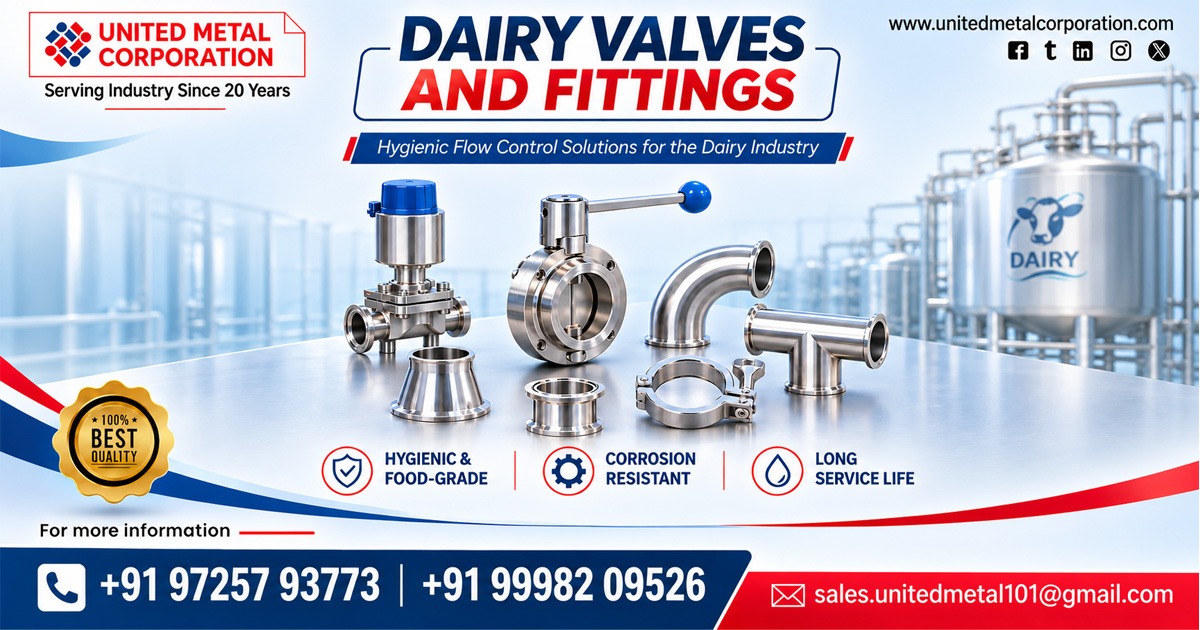
Milk processing lines require careful control over product movement, hygiene and equipment compatibility. Food-Grade Dairy Valves and Fittings for Milk Processing Lines help manage milk flow between processing stages. United Metal Corporation provides manufacturing support from Ahmedabad, Gujarat, India, for industrial piping requirements.
How Dairy Valves Influence Milk Movement Across Processing Stages
In a dairy plant, milk passes through several interconnected operations, including collection, filtration, pasteurisation, cooling, storage and packaging. Valves and fittings connect these stages and help operators manage product movement.
A suitable piping arrangement helps plant operators:
- Control the direction of milk flow between processing equipment.
- Isolate individual sections during cleaning or maintenance.
- Connect tanks, pumps, pipelines and processing vessels.
- Reduce unnecessary pipeline connections and potential leakage points.
- Maintain an organised flow arrangement throughout the processing line.
The valve configuration should match the actual process requirement rather than being selected only by pipe diameter or purchase price.
What Makes a Dairy Piping Component Suitable for Food Processing?
Hygiene is a major consideration when selecting components for milk-contact applications. Internal surfaces, connection arrangements and material compatibility can influence cleaning practices and product handling.
Buyers should examine the following points:
Material suitability: Confirm that the material is appropriate for direct contact with milk and other dairy products.
Surface condition: Check for smooth internal surfaces and avoid configurations that may create unnecessary product-retention areas.
Connection design: Ensure that fittings match the existing sanitary pipeline arrangement.
Cleaning compatibility: Consider whether the component can be included in the plant’s cleaning procedure, including Clean-in-Place (CIP) systems where applicable.
Seal compatibility: Verify that sealing materials are suitable for the product, cleaning chemicals and operating temperatures.
Food-contact suitability should be confirmed through relevant material declarations and supporting documentation rather than assumed from a stainless-steel description alone.
Selecting Valve Types According to the Dairy Process
Different sections of a milk processing plant may require different valve arrangements. The selection depends on the fluid, operating conditions, cleaning method and required flow control.
| Component type | Typical process requirement |
| Sanitary butterfly valve | Isolation and flow control in compatible dairy pipelines |
| Sanitary ball valve | On/off flow control where the design is suitable for hygienic service |
| Dairy check valve | Preventing reverse flow in suitable pipeline arrangements |
| Sanitary diaphragm valve | Flow isolation in applications requiring an appropriate hygienic design |
| Sanitary bends and elbows | Changing pipeline direction |
| Dairy tees | Dividing or combining product-flow routes |
| Sanitary reducers | Connecting pipelines of different diameters |
| Sanitary unions and clamps | Connecting and disconnecting pipeline sections |
Not every valve design is suitable for every milk-contact application. Buyers should check the internal construction, cleaning requirements and manufacturer’s technical information before finalising the configuration.
Material and Connection Details That Buyers Should Verify
Material selection directly affects component suitability, cleaning compatibility and long-term maintenance requirements.
When evaluating Food-Grade Dairy Valves and Fittings for Milk Processing Lines, consider these technical details:
1. Stainless steel grade: Confirm the exact material grade and its suitability for the intended dairy environment. Grades such as SS 304 and SS 316L may be considered depending on the product and cleaning conditions.
2. Internal surface finish: Ask for the available surface-finish details, particularly for product-contact areas.
3. Pipeline dimensions: Match the component size with the existing pipeline’s internal diameter and connection arrangement.
4. Gasket material: Check compatibility with milk, cleaning chemicals and process temperatures.
5. Operating pressure and temperature: Ensure that the component is suitable for the actual operating conditions.
6. Connection standards: Verify whether the plant uses clamp, threaded, welded or another sanitary connection arrangement.
A mismatch in any of these areas can create installation difficulties or complicate routine cleaning.
Integrating Valves and Fittings Into an Existing Milk Processing Line
A dairy processing line usually contains multiple interconnected machines. Installing a new valve or replacing a fitting requires an understanding of the complete pipeline arrangement.
A practical integration process includes:
Step 1 – Identify the Pipeline Section
Determine whether the component will be installed near a milk collection tank, transfer pump, pasteuriser, storage vessel or packaging section.
Step 2 – Confirm Flow Requirements
Identify the direction of flow, required isolation points and whether the component needs to support flow regulation.
Step 3 – Match Pipeline Connections
Check the pipe dimensions, connection type, available installation space and compatibility with existing equipment.
Step 4 – Review Cleaning Arrangements
Confirm that the selected components can be cleaned according to the plant’s established sanitation procedure.
Step 5 – Inspect After Installation
Check connection alignment, sealing, leakage and accessibility before returning the pipeline to production.
Proper coordination between piping components and processing equipment helps reduce avoidable installation complications.
Preventing Hygiene and Maintenance Problems During Daily Operation
Dairy valves and fittings require attention because milk residue, unsuitable seals, damaged connections and poor cleaning practices can affect pipeline hygiene.
Plant maintenance teams should establish inspection and cleaning procedures based on the component manufacturer’s recommendations.
| Common issue | Possible reason | Practical check |
| Leakage around joints | Damaged or incorrectly fitted gasket | Inspect gasket condition and connection seating |
| Difficult valve operation | Wear, deposits or unsuitable operating conditions | Check operating condition and manufacturer’s maintenance guidance |
| Product residue inside the line | Inadequate cleaning or unsuitable component design | Review the cleaning procedure and internal component design |
| Reverse flow | Incorrect valve selection or installation | Check flow direction and check-valve suitability |
| Repeated seal problems | Material incompatibility or incorrect installation | Verify seal material and operating conditions |
Maintenance planning should also include suitable spare gaskets, seals and other replaceable components.
Any maintenance involving a process line should be carried out after appropriate isolation and according to the plant’s safety procedures.
Services
United Metal Corporation can be approached for discussions related to dairy pipeline component requirements.
1. Dairy Valve Selection Assistance: Support in identifying suitable valve configurations according to milk processing and pipeline requirements.
2. Sanitary Fittings Supply: Assistance with pipeline components such as bends, tees, reducers, unions and related fittings.
3. Material and Connection Guidance: Discussion of stainless steel grades, dimensions, sealing arrangements and connection compatibility.
4. Custom Requirement Coordination: Assistance in reviewing component requirements for new dairy projects and existing pipeline modifications.
Location
Ahmedabad is an important industrial and commercial centre for sourcing engineering products and industrial piping components. Food-Grade Dairy Valves and Fittings for Milk Processing Lines are relevant to dairy processing plants, food manufacturers and industrial buyers across Gujarat, including Ahmedabad, Sanand, Changodar, Bavla, Vatva, Naroda, Odhav, Kathwada, Chhatral, Kalol, Gandhinagar, Mehsana, Kadi, Himmatnagar, Anand, Amul Dairy region, Vadodara, Halol, Bharuch, Ankleshwar, Surat, Vapi, Rajkot, Morbi and Jamnagar.
Industrial Dairy Piping Support From United Metal Corporation
Planning dairy piping requirements involves more than identifying a valve size. Buyers must consider material suitability, connection dimensions, cleaning compatibility and the operating conditions of the processing line.
United Metal Corporation supports industrial sourcing and manufacturing-related requirements from Ahmedabad, Gujarat, India. Buyers can visit unitedmetalcorporation.com to discuss dairy valves, sanitary fittings and related stainless-steel component requirements.
Frequently Asked Questions
Q1. Which stainless steel grade is suitable for dairy processing valves and fittings?
A: SS 304 and SS 316L are commonly considered for stainless-steel dairy components. The final selection depends on product contact, cleaning chemicals, operating temperature and corrosion exposure.
Q2. How do I select the correct valve size for a milk processing pipeline?
A: Consider pipeline diameter, required flow rate, operating pressure, fluid characteristics and connection type. The valve should also match the process and cleaning requirements.
Q3. Can sanitary dairy fittings be used with CIP cleaning systems?
A: Yes, components designed for compatible CIP applications can be incorporated into these systems. Confirm internal design, drainage characteristics, seals and cleaning conditions with the manufacturer.
Q4. What information should I provide when requesting a quotation for dairy valves and fittings?
A: Share the required component types, material grade, pipeline dimensions, connection standards, operating conditions, quantities and cleaning requirements. Drawings or existing pipeline details can also help clarify the requirement.
Conclusion
Reliable dairy pipeline planning depends on selecting components that support hygienic product handling, suitable flow control and practical maintenance. Buyers should verify material grades, connection compatibility, sealing arrangements and cleaning requirements before purchasing. United Metal Corporation offers manufacturing support from Ahmedabad, Gujarat, India, for industrial sourcing discussions.
Discuss your dairy pipeline requirements with United Metal Corporation to identify suitable valve and fitting configurations for your milk processing project.
Call Us:
Office – (079) 227 73773
(+91) 9998209526
(+91) 9725793773
Mail Us:
info@unitedmetalcorporation.com
sales@unitedmetalcorporation.com