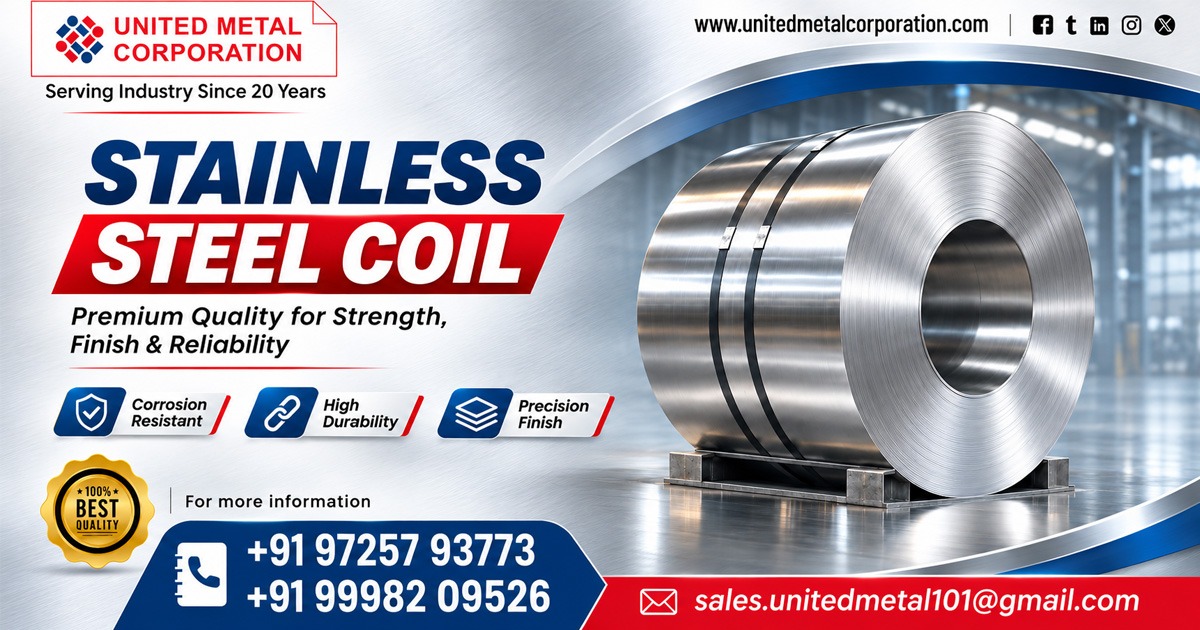
Stainless Steel Coils for Fabrication and Processing are essential for manufacturers facing material consistency and production challenges. United Metal Corporation supports industrial material requirements with manufacturing support from Ahmedabad, Gujarat, India, helping businesses plan suitable stainless steel sourcing.
Understanding How Stainless Steel Coils Fit into Industrial Production
Stainless steel coils are continuous rolls of stainless steel sheets supplied in coiled form. They allow manufacturers to process metal according to their required dimensions, thicknesses, and production methods.
Instead of purchasing individual sheets for every operation, fabrication units can use coil-form material for continuous or batch-based processing.
These coils are commonly considered for:
- Sheet metal fabrication and component manufacturing.
- Industrial equipment and enclosure production.
- Automotive and engineering component processing.
- Kitchen equipment and commercial installations.
- Storage systems, panels, and metal structures.
The main advantage of using coil material is the flexibility it offers during cutting, forming, and fabrication. Manufacturers can process the required quantity according to their production schedule while managing material handling and storage.
What Should Buyers Check When Selecting Stainless Steel Coils?
Selecting the right coil requires more than checking the material price. The steel grade, thickness, surface finish, and processing requirements must match the final application.
Important selection factors include:
| Selection Factor | What Buyers Should Consider |
| Stainless Steel Grade | Select a grade according to corrosion exposure and application requirements. |
| Thickness | Match the thickness with cutting, bending, and forming operations. |
| Coil Width | Check compatibility with available processing machinery. |
| Surface Finish | Choose a suitable finish based on appearance and functional requirements. |
| Coil Weight | Confirm handling, storage, and machine-loading capacity. |
| Mechanical Properties | Consider strength, ductility, and formability requirements. |
| Processing Method | Check suitability for slitting, shearing, stamping, and rolling. |
| Quantity | Estimate regular consumption and production requirements. |
For example, a manufacturer producing formed stainless steel components may prioritize formability, while an equipment fabricator may focus on thickness consistency and surface condition.
Buyers should also consider material availability, delivery schedules, and future production requirements before confirming an order.
From Coil Loading to Finished Components: Understanding the Processing Sequence
Stainless steel coils pass through different processing stages depending on the final product. A typical fabrication workflow includes the following steps.
Step 1: Coil Inspection and Preparation
The incoming coil is checked for grade identification, thickness, width, surface condition, and visible damage. Proper inspection helps identify material issues before production begins.
Step 2: Uncoiling and Material Feeding
The coil is mounted onto an appropriate uncoiling system. The steel strip is gradually released and guided into the processing line while maintaining suitable material alignment.
Step 3: Cutting, Slitting, or Forming
The material is processed according to the required dimensions.
Common operations include:
- Slitting wider coils into narrower strips.
- Cutting sheets to specified lengths.
- Bending and forming components.
- Rolling or stamping parts for fabrication.
Step 4: Final Inspection and Storage
Processed material is checked for dimensional accuracy, surface condition, and visible defects. Finished sheets or components are then handled and stored appropriately to avoid unnecessary damage.
The exact processing arrangement depends on the machinery, material grade, and finished-product requirements.
Material Quality Checks That Matter Before Placing an Order
Material inconsistency can create difficulties during fabrication, particularly when production involves repeated bending, cutting, or forming operations.
Before purchasing, industrial buyers should verify the following:
- Grade identification: Confirm that the supplied stainless steel grade matches the purchase requirement.
- Thickness consistency: Check whether the material thickness is suitable throughout the coil.
- Surface condition: Inspect for scratches, dents, stains, and other visible imperfections.
- Width and dimensions: Match the coil dimensions with the processing equipment.
- Edge condition: Check for damaged or irregular edges that may affect further processing.
- Material documentation: Request available test certificates or inspection documents where required.
- Packaging: Ensure suitable protection against handling damage and moisture exposure.
- Quantity verification: Confirm the supplied weight and dimensions against the purchase order.
Buyers should also clarify acceptable material tolerances and inspection procedures before finalizing bulk orders.
Matching Coil Requirements with Different Fabrication Projects
Every fabrication project has different material requirements. A coil suitable for one production line may not be appropriate for another.
The selection of Stainless Steel Coils for Fabrication and Processing should therefore be connected to the actual manufacturing process.
For project planning, buyers should evaluate:
- Production volume: Determine the expected daily or monthly material consumption.
- Machine compatibility: Check the maximum coil width, weight, and thickness supported by the equipment.
- Material grade: Select according to the working environment and finished-product requirements.
- Processing complexity: Consider whether the material will undergo deep drawing, bending, stamping, or other operations.
- Storage arrangements: Provide suitable space and equipment for safe coil handling.
- Supply planning: Coordinate order quantities with production schedules to avoid material shortages.
Clear communication about these requirements helps buyers and suppliers identify a suitable material arrangement.
SERVICES
- Stainless Steel Material Consultation: Understanding application requirements, grade preferences, and processing needs before material selection.
- Product Selection Assistance: Helping buyers evaluate suitable coil dimensions, thickness, and surface finish requirements.
- Industrial Order Coordination: Supporting material quantity planning and coordination according to purchasing requirements.
- Technical and Product Support: Assisting customers with product-related queries and material requirement discussions.
LOCATION
Industrial fabrication, engineering, automotive, equipment manufacturing, and metal processing businesses across Gujarat require stainless steel materials for their regular production activities. Manufacturing support from Ahmedabad, Gujarat, India helps address regional sourcing and material coordination requirements. Relevant industrial locations include Ahmedabad, Sanand, Changodar, Bavla, Dholka, Gandhinagar, Kalol, Mehsana, Kadi, Vadodara, Halol, Savli, Bharuch, Ankleshwar, Dahej, Surat, Hazira, Vapi, Valsad, Rajkot, Morbi, Jamnagar, Bhavnagar, and Kutch.
Why Choose United Metal Corporation for Stainless Steel Material Requirements?
Choosing a suitable material supplier involves understanding product requirements, order specifications, and delivery expectations.
United Metal Corporation can be approached for discussions related to stainless steel material sourcing and industrial purchasing requirements.
Customers can connect with the company to discuss:
- Required stainless steel grades and dimensions.
- Coil thickness, width, and quantity requirements.
- Material suitability for fabrication and processing.
- Order planning and product-related assistance.
With manufacturing support from Ahmedabad, Gujarat, India, the company provides a regional point of contact for industrial material enquiries.
Visit the official website: https://unitedmetalcorporation.com/
Frequently Asked Questions
Q1: Which stainless steel grade should I select for fabrication work?
A: The appropriate grade depends on corrosion exposure, forming requirements, strength, and the working environment. Buyers should discuss the intended application before selecting a grade.
Q2: How do I determine the correct coil thickness and width?
A: Check the finished component dimensions and the processing machinery’s capacity. The selected thickness and width should support the required cutting, bending, or forming operations.
Q3: Can stainless steel coils be used for automated processing lines?
A: Yes. Coil-form stainless steel can be processed using compatible automated uncoiling, feeding, slitting, and cutting systems. Machine capacity and material specifications must be checked beforehand.
Q4: What should I inspect when receiving a stainless steel coil?
A: Verify the material grade, weight, thickness, width, packaging, and surface condition. Compare the supplied material with the purchase order and available quality documentation.
Conclusion
Selecting the right Stainless Steel Coils for Fabrication and Processing requires attention to grade, dimensions, surface finish, and production compatibility. Industrial buyers in Ahmedabad and across Gujarat can discuss their material requirements with United Metal Corporation for suitable sourcing and manufacturing support.
Looking for stainless steel material for your fabrication or processing requirements? Contact United Metal Corporation through unitedmetalcorporation.com to discuss your product specifications and purchasing needs.
Call Us:
Office – (079) 227 73773
(+91) 9998209526
(+91) 9725793773
Mail Us:
info@unitedmetalcorporation.com
sales@unitedmetalcorporation.com