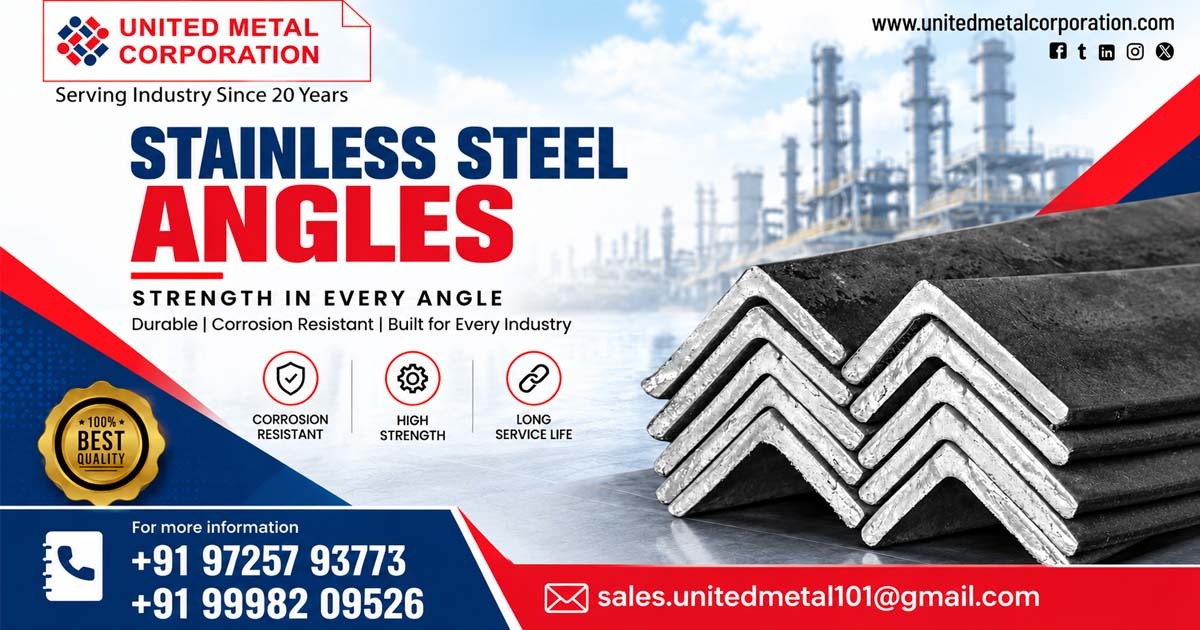
When sourcing stainless steel angles for fabrication or plant maintenance, will the supplied section match the drawing, corrosion conditions and installation requirements? Buyers in Sikkim should verify material grade, dimensions and documentation before confirming an order.
1. Why the Material Grade Matters More Than the Name on the Quotation
A stainless steel angle is an L-shaped metal section used to support frames, reinforce assemblies, fabricate brackets and connect structural components. However, specifying only “stainless steel angle” leaves several important purchasing decisions unresolved.
The required grade depends on the environment, cleaning chemicals, moisture exposure and mechanical demands of the application.
- Grade 304: Often considered for general fabrication and indoor equipment where the exposure conditions are suitable.
- Grade 316: May be preferable where greater resistance to certain chlorides and corrosive chemicals is required.
- Grade 304L or 316L: Low-carbon alternatives that may be appropriate when welding-related corrosion considerations influence material selection.
- Other grades: Grades such as 202, 321 and 310 may suit particular cost, fabrication or temperature requirements, subject to engineering verification.
These grades are not interchangeable in every application. The correct selection should be based on the actual operating environment rather than price or grade availability alone. United Metal Corporation lists multiple stainless steel grades in its angles, channels and flats product range.
2. What Should a Buyer Specify Beyond the Angle Size?
Two stainless steel angles can have similar external dimensions but differ in thickness, manufacturing method, tolerances and material properties. These differences can affect fabrication accuracy and the finished assembly.
Before requesting a quotation from a Stainless Steel Angles Supplier In Sikkim, prepare a clear material requirement covering the following details:
- Leg dimensions: State both leg lengths, such as 40 × 40 mm or 50 × 50 mm.
- Thickness: Specify the required thickness in millimetres.
- Length: Confirm standard stock length or the required cut length.
- Material grade: Identify the exact grade instead of writing only SS.
- Manufacturing form: Confirm whether the required profile is hot-rolled, roll-formed, welded or another specified construction.
- Applicable standard: Identify the relevant product standard and acceptance criteria for the intended application.
An equal-leg angle has two legs of the same nominal length, while an unequal-leg angle has different leg lengths. The distinction matters when an assembly has limited space or requires a particular support geometry.
For pressure-vessel or boiler-related applications, ASTM A479/A479M covers specified stainless steel bars and shapes, including angles, for its defined scope. Do not assume that this standard automatically applies to every general-purpose angle; confirm the design code and procurement specification first.
ASTM Store+1
3. How Dimensional Checks Prevent Fabrication Problems
The angle size printed on an order is not the only dimension that matters. A fabricator may also need to verify leg lengths, thickness, straightness, squareness and the condition of the edges.
A profile that differs from the approved drawing can create gaps during fit-up, complicate welding or require additional correction at the workshop.
For incoming inspection, compare the delivered material with the purchase order and approved drawing.
- Measure the two legs at representative points.
- Check thickness using a suitable measuring instrument.
- Inspect the profile for visible bending, twisting, dents or handling damage.
- Confirm that the supplied lengths meet the agreed cutting and dimensional requirements.
- Review the applicable tolerances rather than assuming that every commercial profile follows the same limits.
Technical insight: Tolerances should be agreed before ordering, not debated after fabrication begins. The acceptable deviation depends on the product standard, the supplier’s declared manufacturing route and the requirements of the finished assembly. A decorative support bracket and a closely fitted machine frame may not have the same dimensional acceptance criteria.
4. What Material Documents Should Accompany the Supply?
Material identification is important when angles will be used in equipment frames, industrial platforms, processing areas or assemblies subject to inspection.
Before placing an order, discuss which documents are available and which are mandatory for the project.
| Document or record | What the buyer should verify |
| Material Test Certificate (MTC) | Grade, heat or batch identification, and reported test results where applicable |
| Purchase specification | Agreed grade, size, thickness, length and standard |
| Dimensional inspection record | Measured dimensions against the specified tolerances, where required |
| Traceability details | Whether the material marking or batch reference can be linked to the supplied documents |
| Inspection and acceptance requirements | Any project-specific testing, third-party inspection or documentation conditions |
Not every order requires every document. Requirements depend on the end use, governing specification and buyer’s quality plan.
If traceability is essential, confirm that the supplied pieces, bundles or markings can be linked to the relevant material records. A certificate that cannot be connected to the actual shipment may not satisfy a project’s inspection requirements.
5. Planning Stainless Steel Angle Procurement for Sikkim
Sourcing from outside the state can be practical when the required dimensions or grades are not readily available locally. However, the quoted material price is only one part of the purchasing decision.
For buyers seeking a Stainless Steel Angles Supplier In Sikkim, the procurement plan should account for the delivery destination, unloading arrangements, quantity, packaging and project schedule.
Consider these points before comparing quotations:
- Transport route: Confirm the destination pin code, delivery access and the logistics provider’s serviceability.
- Material availability: Ask whether the exact grade, size and thickness are available or require procurement or production.
- Shipment protection: Agree on packaging that limits scratching, contamination and handling damage.
- Delivery schedule: Request an estimated dispatch date and transit estimate, allowing for possible route or weather-related disruption.
- Order consolidation: Where suitable, evaluate whether combining different required sizes into one planned shipment reduces handling and coordination costs.
A practical sourcing scenario
Imagine a maintenance contractor in Rangpo needs stainless steel angles for a replacement equipment frame. The initial quotation lists a grade and nominal size, but the site drawing also specifies thickness, cut lengths and a material certificate.
The contractor should clarify these requirements before comparing prices. A lower quotation is not necessarily the more economical option if the material needs additional cutting, fails dimensional inspection or arrives without required documentation.
This is an illustrative procurement scenario, not a reported customer project.
6. A Pre-Order Checklist for Procurement Teams
Use this checklist before approving a supplier’s quotation:
- Confirm the required grade against the exposure conditions, cleaning process and design requirements.
- Share the drawing or complete dimensions, including leg lengths, thickness and cut lengths.
- Specify the applicable material standard, tolerances and certificate requirements.
- Request confirmation of stock availability, quantity, packaging and dispatch schedule.
- Verify the delivery location, freight charges, unloading responsibilities and estimated transit time.
- Agree on inspection, rejection and replacement procedures before releasing the purchase order.
These checks help procurement teams compare quotations on a consistent basis and reduce avoidable discrepancies between the ordered material and the actual project requirement.
7. Four Relevant Service and Support Areas
The following are useful support requirements for buyers to discuss with a supplier. Confirm availability and scope directly before treating any item as a committed service.
1. Material requirement review: Clarify grade, dimensions, quantity and intended application before quotation.
2. Product selection coordination: Discuss suitable available angle sizes and material grades against the buyer’s stated requirements.
3. Documentation coordination: Confirm the availability of applicable material certificates and other agreed inspection records.
4. Dispatch and delivery coordination: Clarify packaging, order readiness, freight arrangements and delivery expectations for the Sikkim destination.
8. Regional Sourcing Considerations for Sikkim Projects
Industrial maintenance, building fabrication, equipment installation and infrastructure projects can have different material and delivery requirements. Buyers should identify the actual installation site and determine whether the angle is intended for an exposed structure, an indoor assembly, a wet processing area or another environment.
For projects in Sikkim, it is particularly useful to clarify access to the delivery point, site storage conditions and the schedule for moving materials from unloading areas to the installation location. Local conditions should be assessed for the individual project rather than assuming that one specification suits every site.
Relevant towns and business locations for regional procurement planning include Gangtok, Rangpo, Singtam, Jorethang, Namchi, Melli, Pakyong, Gyalshing, Soreng, Mangan, Ravangla, Pelling, Rhenock, Rongli, Ranipool, Tadong, Deorali, Majitar, Dikchu, Nayabazar, Yangang, Chungthang, Samdong and Bermoik.
These locations are provided as geographic references for planning and inquiry purposes, not as a claim of confirmed supplier coverage or delivery availability.
9. United Metal Corporation: Supplier Information and Manufacturing Base
United Metal Corporation lists stainless steel angles, channels and flats alongside other metal products. Its published angle product information includes grades such as 202, 304, 304L, 316 and 316L, among others.
The company states that its manufacturing and warehouse facilities are in Ahmedabad, Gujarat, India. Buyers in Sikkim can use the company’s official website to review the product range and submit an inquiry about the specific material requirements.
For an inquiry from Sikkim, share the grade, dimensions, quantity, documentation requirements and delivery destination to help clarify the quotation requirements. Confirm current stock, transport arrangements and delivery commitments directly with the company.
10. Frequently Asked Questions
1. Which stainless steel grade should I choose for angles used in a wet environment?
The choice depends on moisture, chloride exposure, cleaning chemicals and maintenance conditions. Compare grades such as 304 and 316 against the actual environment rather than selecting by grade name alone.
2. Can stainless steel angles be ordered in custom lengths for fabrication?
Custom cutting may be possible depending on supplier capabilities and stock dimensions. Confirm the required lengths, cutting tolerances, quantity and whether cut pieces will retain the necessary identification.
3. How can I check whether the supplied angle matches my purchase order?
Measure the leg lengths and thickness, inspect the profile condition, and compare the results with the agreed tolerances. Check material markings and certificates where grade verification and traceability are required.
4. What affects the delivered price of stainless steel angles in Sikkim?
The material grade, profile dimensions, thickness, quantity, cutting requirements, documentation, packaging and freight arrangements can all influence the final cost. Request an itemised quotation to compare suppliers fairly.
11. Conclusion
Reliable stainless steel angle procurement starts with a clear material specification, not simply a price comparison. Grade suitability, dimensional tolerances, documentation and delivery planning all influence whether the supplied material meets project requirements. Buyers in Sikkim should resolve these details before approving an order to reduce fabrication and procurement risks.
Contact United Metal Corporation through its official website to discuss your stainless steel angle requirements, confirm product availability and request a quotation for delivery to Sikkim.
Call Us:
Office – (079) 227 73773
(+91) 9998209526
(+91) 9725793773
Mail Us:
info@unitedmetalcorporation.com
sales@unitedmetalcorporation.com